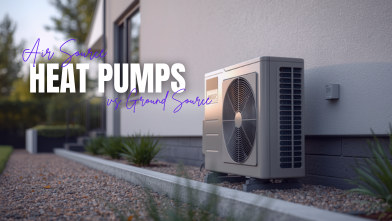
If you are researching air vs ground source heat pump UK, you are already asking the right question. For most homeowners, the decision is not whether heat pumps work. It is which type makes the most sense for the property, the budget, the available space, and the level of disruption you are willing to accept during installation. Energy Saving Trust’s current UK guidance makes that clear. Both systems can heat a home efficiently, but they suit different circumstances.
Featured snippet answer: Neither system is universally better. In the UK, an air source heat pump is usually the more practical choice where budget and space are tighter, while a ground source heat pump is often worth considering where you have enough land, want the highest seasonal efficiency, and can justify the greater installation cost and disruption.
Air vs ground source heat pump UK. Which is better?
The honest answer is that the better option depends on five things. Your property type, your outdoor space, your budget, your efficiency goals, and how practical the installation will be. Energy Saving Trust says that if you are limited by budget or space restrictions, an air source heat pump is more likely to suit you. It also says that a ground source system is likely to be more efficient than an equivalent air source system, giving lower running costs and lower carbon emissions, but costing more to install.
That is why this is not really a winner-takes-all comparison. It is a suitability decision. A well-designed air source heat pump can be the better investment for a typical suburban home. A ground source heat pump can be the stronger long-term option for a larger property with land, stable renovation plans, and an owner prepared for higher upfront cost.
How air source heat pumps work
An air source heat pump takes heat from the outside air and transfers it into the water in your home’s central heating system. That heat can then be used for radiators, underfloor heating, and hot water stored in a cylinder. Energy Saving Trust explains that the system uses refrigerant and a compressor to raise the temperature before passing the heat into the home. The government’s consumer guidance adds that heat pumps can do this even in sub-zero weather.
For UK homeowners, the key benefit is practicality. Air source systems are the most common domestic heat pump type in the UK, they are suitable for most types of home, and the main unit normally sits outside the property. That makes them easier to fit in many cases than a ground source system.
How ground source heat pumps work
A ground source heat pump works on the same overall principle, but instead of taking heat from the air, it takes heat from the ground through buried pipework. That pipework is usually installed in trenches or through boreholes. The ground provides a more stable source temperature through the year, which is one reason ground source systems tend to be more efficient overall.
In practical terms, this makes ground source far more dependent on site conditions. Energy Saving Trust says these systems are better suited to properties with a large garden or enough outdoor space to run underground loops or boreholes. If you do not have that kind of space, the decision can often be made very quickly. Ground source may simply not be a realistic option.
Installation requirements and disruption
This is where the difference becomes most obvious.
Air source heat pumps are usually simpler to install. You need room for the outdoor unit and, in most cases, space indoors for a hot water cylinder. Ground source systems need far more from the site because the ground loop has to be buried or drilled in. Energy Saving Trust notes that trenches or boreholes add extra work and extra cost. That also means more disruption during installation.
For many UK homes, especially standard urban and suburban properties, that practical difference is decisive. Air source tends to be the more accessible route. Ground source becomes more attractive where the land is there already and excavation is not a major obstacle.
Upfront cost and long-term value
On current Energy Saving Trust figures, an air source heat pump installation is around £11,000, while a ground source heat pump is around £29,000. If boreholes are needed, the ground source figure can go significantly higher. Those costs still vary by property size, whether the home is new-build or existing, and how much work is needed to adapt the existing heating system.
This does not automatically mean air source is the better value. Ground source systems tend to be more efficient across the year, which can mean lower running costs. But the extra installation cost is substantial, so the stronger option financially depends on how long you expect to stay in the home, how important long-term efficiency is to you, and whether the site makes a ground source installation straightforward rather than complex.
Efficiency and running performance
Efficiency is one of the strongest arguments in favour of ground source, but it needs context.
Energy Saving Trust explains that heat pump efficiency depends on the source temperature. Air temperatures fluctuate through the year, while soil temperature is much steadier and usually stays above 5°C. That gives ground source systems an efficiency advantage overall, especially during colder periods when heating demand is highest. At the same time, air source systems can still perform very effectively in UK conditions and may even be slightly more efficient on milder days when the air is warmer than the ground.
The more important lesson is that neither system performs at its best without proper design. Energy Saving Trust’s installer toolkit says an accurate room-by-room heat loss calculation is fundamental if a heat pump is going to heat the property adequately at relatively low flow temperature and high efficiency. That applies to both system types.
Maintenance, lifespan thinking, and aftercare
A premium comparison should not pretend that one technology is “set and forget” while the other needs constant attention. Energy Saving Trust says heat pumps need no more maintenance than a gas boiler and recommends an annual service to keep the system clean and working efficiently. That advice applies broadly to heat pumps rather than only one source type.
Where the comparison does differ slightly is in how the systems are physically arranged. Air source systems have an outdoor unit exposed to weather and siting considerations. Ground source systems do not need an outdoor fan unit, but they do need a larger indoor unit and buried or drilled ground loops. In practice, homeowners should compare annual servicing, warranty terms, installer support, and build quality rather than assume one fixed lifespan number automatically makes one type better. That is a judgement grounded in system layout and maintenance guidance, rather than a hard official lifespan ranking.
Noise and space needs
Noise is a more relevant issue for air source because the main unit sits outside the home. That does not mean it is unsuitable, but it does make siting more important. Ground source systems do not have an outdoor unit, so external noise is usually less of a consideration.
Space works the other way. Air source needs much less land outside, while ground source needs enough space for trenches or a borehole approach. Inside the home, both typically need space for hot water storage, and Energy Saving Trust says heat pumps ideally need room for a cylinder.
Comparison table. Air source vs ground source
| Feature | Air source heat pump | Ground source heat pump |
|---|---|---|
| Heat source | Outside air | Ground via trenches or boreholes |
| Typical installation cost | Around £11,000 | Around £29,000, more with boreholes |
| Outdoor space needed | Usually modest | Usually significant |
| Installation disruption | Lower | Higher |
| Seasonal efficiency | Strong, but varies more with weather | Usually higher overall |
| External noise consideration | Yes, because of the outdoor unit | Usually less relevant |
| Best fit | Most UK homes with limited space or budget | Homes with land and long-term efficiency goals |
The broad comparison above reflects current Energy Saving Trust guidance on suitability, installation cost, source temperature and efficiency.
When air source heat pumps make more sense
Air source usually makes more sense when:
- you have limited outdoor space
- you want lower installation disruption
- you are working to a more moderate budget
- you live in a typical UK house where a ground loop is unrealistic
- you want the most practical route into low-carbon heating
This is why air source is so often the better choice for mainstream UK homes. It is not always the absolute efficiency winner, but it is often the best mix of practicality, cost and performance.
When ground source heat pumps are worth considering
Ground source is worth serious consideration when:
- you have a large garden or suitable land
- trenches or boreholes are practical on site
- you want the strongest long-term efficiency case
- you are already undertaking major renovation or site works
- you are comfortable with a much higher upfront spend for a more premium installation approach
For some rural or larger detached properties, that combination can make ground source the better premium choice. The efficiency advantage is real. It is the practicality and cost barrier that stops it being the default answer.
Pros and cons at a glance
Air source heat pumps
Pros
- cheaper to install than ground source
- easier to fit in most UK homes
- less disruptive installation
- suitable for most property types
Cons
- efficiency varies more with outdoor temperature
- outdoor unit needs careful siting
- can be slightly less efficient overall than ground source
Ground source heat pumps
Pros
- generally more efficient across the year
- lower running costs in many cases
- no outdoor fan unit
- strong fit for larger sites and long-term thinking
Cons
- much higher installation cost
- requires land and more complex groundwork
- more disruption during installation
- often unrealistic for smaller plots or tightly constrained homes
Homeowner checklist before choosing
Before deciding on the best heat pump type for UK homes in your case, ask yourself:
- Do I have enough outdoor space for trenches or boreholes?
- Am I comparing upfront cost only, or whole-life value?
- Is the house reasonably well insulated?
- Will the system work with my radiators or would upgrades help?
- Do I have room for a hot water cylinder?
- How much installation disruption am I realistically willing to accept?
- Has a proper heat loss calculation been done?
If you already know your home needs a property-specific recommendation rather than a generic comparison, you can request a tailored quote based on your layout, budget and heating goals.
Quick summary for skim readers
- Air source is usually the more practical choice for most UK homes.
- Ground source is usually the more efficient choice overall, but it costs much more to install.
- Space and disruption are often the deciding factors.
- Correct sizing, emitter compatibility and good installation matter just as much as the source type.
- The better system is the one that fits the property properly, not the one with the strongest headline claim.
If you want help comparing your own home rather than broad examples, you can contact the team here for a more specific view.
FAQ
Which is better air source or ground source heat pump?
Neither is automatically better for everyone. Air source is usually better where space and budget are tighter, while ground source is often better where you have enough land and want stronger seasonal efficiency.
Is ground source more efficient than air source?
Generally, yes. Energy Saving Trust says ground source systems tend to be more efficient across the year because ground temperatures are more stable than air temperatures.
Is air source cheaper to install than ground source?
Yes. Current Energy Saving Trust figures put air source at around £11,000 and ground source at around £29,000, with boreholes pushing the ground source cost even higher.
Do both systems work in UK weather?
Yes. Government guidance says heat pumps can work even in sub-zero weather, and Energy Saving Trust says air source systems can operate effectively in extreme UK conditions, although efficiency is affected by temperature.
Do I need a lot of space for a ground source heat pump?
Usually, yes. Ground source systems normally need enough outdoor space for trenches or boreholes, which is why they are better suited to homes with larger gardens or land.
Conclusion
The right answer to air vs ground source heat pump UK is rarely about choosing the “best” technology in the abstract. It is about choosing the system that fits the property, the land, the budget and the installation reality. Air source is usually the more practical and affordable option for most UK homes. Ground source is usually the more efficient and premium option where the site makes it viable. In both cases, the strongest results come from accurate heat loss calculations, sensible system design and good installation rather than from source type alone.
Leave a Reply